ai
Events

AI regulation’s measurement problem: Assessing the risks of automated decision-making systems to health, safety, fundamental rights, and the rule of law
Professor Dr. Carsten Gerner-Beuerle, Professor of Commercial Law, Faculty of Laws, University College London
The Network for Artificial Intelligence and Law (NAIL) invites you to its next event. We are delighted to welcome Professor Dr. Carsten Gerner-Beuerle, Faculty of Laws, University College London. He will talk about the difficulties of assessing the precise risks to health, safety, fundamental rights and the rule of law when regulating artificial intelligence. The lecture will be followed by a discussion around the topic. The event will be held in English.
After the lecture and discussion, we would like to invite you to end the evening with us in a relaxed atmosphere, with pretzels and wine in the south lounge.
You can participate in presence or online. Please register for the event using the following link: Registration
Institutions
- Network for Artificial Intelligence and Law (NAIL)

AI weather forecasting: Past, present and future
Weather forecasting is critical for a range of human activities including transportation, agriculture, industry, as well as the safety of the general public. Over the last two years, machine learning models have shown that they have the potential to transform the complex weather prediction pipeline, but current approaches still rely on numerical weather prediction (NWP) systems, limiting forecast speed and accuracy. In this talk, some of the background on these developments will be given. A new generation of machine learning model will then be introduced which can replace the entire operational NWP pipeline. Aardvark Weather, an end-to-end data-driven weather prediction system, ingests raw observations and outputs global gridded forecasts and local station forecasts. Further, it can be optimised end-to-end to maximise performance over quantities of interest. It will be shown that the system outperforms an operational NWP baseline for multiple variables and lead times for gridded and station forecasts. Finally, the talk will end by discussing how these ideas might develop over the next few years, including their application to multiple parts of the Earth system on multiple time-scales, and their potential impact on climate modelling.
Institutions
- AI for Good
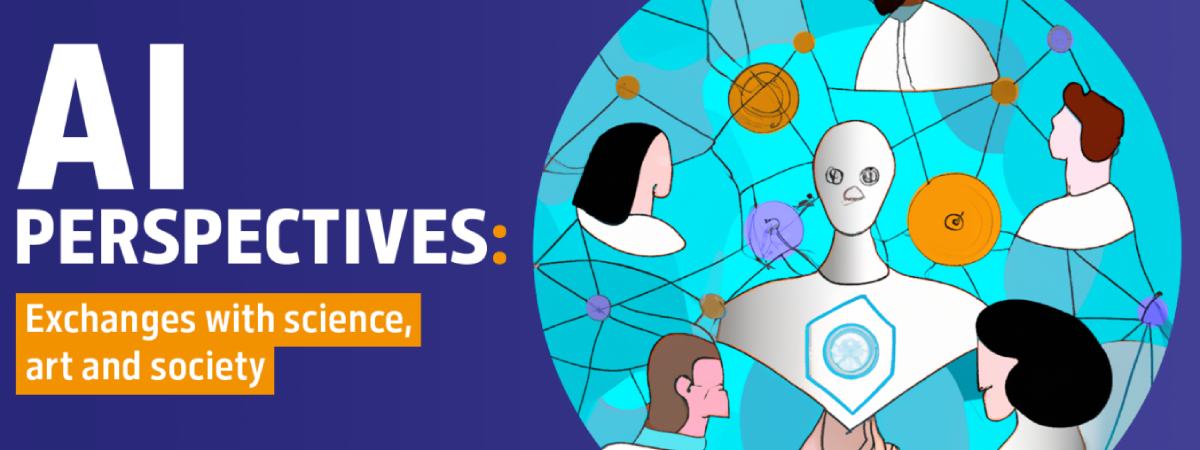
AI-Perspectives: New series of events
What is AI Perspectives?
AI Perspectives is a new series of events that explores important questions in the field of AI addressing specialists of various disciplines from the natural sciences, the humanities and the arts.
Overview
AI is everywhere. Also at DESY. High time to launch its interdisciplinary research forum AI Perspectives focusing on AI and reflecting the trans- and interdisciplinary field that is Artificial Intelligence. We at DESY are interested in looking at the innovative field from a variety of different angles and discuss them with the public. This is why DESY sets up an interdisciplinary research forum on AI.
The research forum will be divided into two different events: an academic workshop seminar as well as a public panel discussion in the evening with the invited public. Participants are primarily young academics and artists, scientists and philosophers working in the field of AI. For the evening event the public is invited to join in the conclusions and preliminary results of the workshop session earlier in the day and pose their own pressing questions to the interdisciplinary group. The workshop seminar will be conducted in English, while the evening event will be in German.
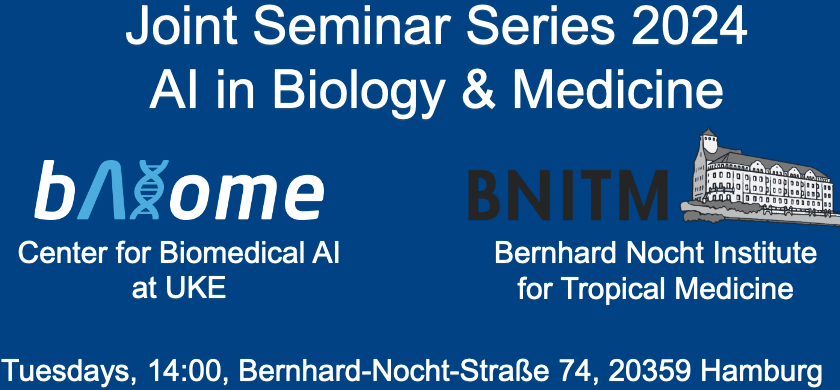
Al for biomedical imaging: computational superresolution and more - BNITM seminar series "AI in Biology and Medicine".
bAIome Center for biomedical AI (UKE) and Bernhard Nocht Institute for Tropical Medicine (BNITM) will host the seminar series entitled “AI in biology and Medicine”. This series aims to capture a broad audience and promote cross institutional collaboration. Our expert speakers will give an overview and insight into particular AI/data science methods being developed in key areas of biology and medicine. We will have drinks and snacks following each seminar to facilitate exchange.
René Werner, Institute for Applied Medical Informatics, UKE
For further details and hybrid links, please go to the webpage AI in Biology & Medicine

Algorithmic Monoculture and the Ethics of Systemic Exclusion
As the number of job applications increase, hiring managers have turned to artificial intelligence (AI) to help them make decisions faster, and perhaps better. Where once each manager did their own first rough cut of files, now third party software algorithms sort applications for many firms. Human mistakes are inevitable, but fortunately heterogenous. Not so with machine decision-making. Relying on the same AI systems means that each firm makes the same mistakes and suffering from the same biases. When the same person re-encounters the same model again and again, or models trained on the same dataset, she might be wrongly rejected again and again. In this talk, I will argue that it is wrong to allow the quirks of an algorithmic system to consistently exclude a small number of people from consequential opportunities, and I will suggest solutions that can help ameliorate the harm to individuals.
Prof. Dr. Kathleen A. Creel (Northeastern University, Boston, MA, USA)
Kathleen Creel is an Assistant Professor at Northeastern University, cross appointed between the Department of Philosophy and Religion and Khoury College of Computer Sciences. Her research explores the moral, political, and epistemic implications of machine learning as it is used in non-state automated decision making and in science. She co-leads Northeastern’s AI and Data Ethics Training Program and is a winner of the International Association of Computing and Philosophy’s 2023 Herbert Simon Award.
Institutions
- UHH

Alles KI – oder was?
Die KI-Werkstatt richtet sich an Hochschullehrende, Kolleg*innen aus Service- und Supporteinrichtungen der Hochschullehre an den Hamburger Hochschulen sowie an interessierte Bürgerinnen und Bürger aus Hamburg. Wir würden uns über Ihr Interesse und Ihre Mitwirkung bei der Erschließung unterschiedlicher KI-Anwendungsbereiche sehr freuen.
Programmablauf
- 14:30 - 15:00 Uhr: Ankommen und Begrüßungskaffee
- 15:00 - 15:45 Uhr: Eröffnung
- Auftakt von Dr. Sophie Heins und Franz Vergöhl (HCU – HafenCity Universität Hamburg) zum Thema "KI gemeinsam entdecken"
- 15:45 - 16:30 Uhr: Erste Tischrunde
- 16:30 - 17:00 Uhr: Pause mit Kaffee und Kuchen
- 17:00 - 17:45 Uhr: Zweite Tischrunde
- 17:45 - 18:30 Uhr: Dritte Tischrunde
- 18:30 - 19:00 Uhr: Verabschiedung und Get-together
Anmeldung hier
Institution
- Multimedia Kontor Hamburg gGmbH

Alles nur Fake? KI, Kunst und Autorschaft
KI hält zunehmend Einzug in die Kunst: Apps erzeugen Gemälde, KI komponiert Musik, und Chatbots schreiben Gedichte.
Der Vortrag setzt sich mit der Frage auseinander, ob KI tatsächlich Kunst schaffen kann bzw. ob es einen wesentlichen „menschlichen Faktor“ bei der Kunstproduktion gibt. Catrin Misselhorn stellt Thesen aus ihrem Buch „Künstliche Intelligenz – das Ende der Kunst?“. Sie betrachtet vor dem Hintergrund der wachsenden Fähigkeiten der KI traditionelle Konzepte der Kunsttheorie neu, etwa die Kunstdefinition und die Rolle von Autorschaft.
Es wird argumentiert, dass Autorschaft eine notwendige Bedingung dafür ist, dass etwas ein Kunstwerk ist, welches Kunstwerk es ist und welchen Wert ihm als Kunstwerk zukommt. Autorschaft lässt sich wiederum auf ästhetische Verantwortung zurückführen.
Obwohl KI als ästhetischer Akteur fungieren kann, kann sie keine ästhetische Verantwortung tragen. Daher kann sie weder allein noch in Zusammenarbeit mit Menschen Autorin von Kunstwerken sein.
Allerdings ist KI in der Lage „Fake-Art“ zu produzieren, also Objekte, die in ihren wahrnehmbaren Eigenschaften nicht von Kunstwerken zu unterscheiden sind. Der Vortrag schließt mit der Frage, wie sich das massive Auftreten von KI-generierter Fake-Art auf die Kunstpraxis auswirkt.
Institutions
- Artificial Intelligence Center Hamburg (ARIC) e.V.
ARIC Brown Bag Session: How to integrate AI into your dev process
Almost every software team experiments with AI. But how many have actually established a structured workflow that helps turn random attempts into measurable results?In his practical session, Lou Dutko, CTO at Lemberg Solutions, shares his team’s experience of moving beyond experimentation towards systematic implementation of AI tools during software development. What you’ll find out:- Workflow evolution: How the scope of tasks has shifted for each project role- Delegation and governance: What can be easily delegated to AI, and what still needs human oversight and approval- Phase-by-Phase ROI: How much costs can be saved eventually at each stage of the development processThis webinar is for tech leaders looking to introduce AI tools into their engineering processes with structure, governance, and precision.
Folgt uns über Eventbrite oder schaut regelmäßig auf unsere Website vorbei, um über alle Termine informiert zu sein.
Dieses Format wird im Rahmen des EDIH Hamburg, mit Unterstützung durch die Europäische Union und der Hamburgischen Investitions- und Förderbank angeboten. #EDIHHamburg
Institutions
- Artificial Intelligence Center Hamburg (ARIC) e.V.
ARIC Brown Bag Session: Ion-trap quantum computers based on NFQC
Vortragssprache: Englisch
Qudora Technologies builds ion trap quantum computers using its proprietary Near Field Quantum Control (NFQC) technology. Leveraging in house microfabrication and a scalable on-chip architecture, the company targets fault tolerant processors for on-premises deployment and quantum computing as a service.
Institutions
- Artificial Intelligence Center Hamburg (ARIC) e.V.
ARIC Brown Bag Session: KI als Kollegin oder Konkurrenz?
Institutions
- Artificial Intelligence Center Hamburg (ARIC) e.V.
ARIC Brown Bag Session: KI im Arbeitsschutz: Halluzination trifft Präzision
Institutions
- Artificial Intelligence Center Hamburg (ARIC) e.V.
ARIC Brown Bag Session: KI und Energieverbrauch
Institutions
- Artificial Intelligence Center Hamburg (ARIC) e.V.
ARIC Brown Bag Session: Politische Informationssuche mit Generativer KI
Eva Luise Knor ist seit Juni 2023 wissenschaftliche Mitarbeiterin am Leibniz-Institut für Medienforschung | Hans-Bredow-Institut (HBI) und an der Universität Hamburg. In ihrer Forschung beschäftigt sie sich mit dem Einfluss Künstlicher Intelligenz auf politische Meinungsbildungsprozesse im Kontext der Mensch-Maschine-Kommunikation.
Generative KI-Systeme wie ChatGPT werden zunehmend als politische Informationsquelle genutzt. Dabei entstehen neue Chancen für den Zugang zu Informationen, zugleich aber auch Risiken durch plausibel wirkende, potenziell fehlerhafte oder verzerrte Inhalte. Im Vortrag soll sich der Frage genähert werden, wie Endnutzende mit dieser Unsicherheit in politischen Informationskontexten umgehen, ob und wie menschenähnliche Interaktionen mit KI politische Meinungsbildung beeinflussen und auf welche Weise Techunternehmen implizite Erwartungen an die Verlässlichkeit von KI-Technologien prägen.
Institutions
- Artificial Intelligence Center Hamburg (ARIC) e.V.
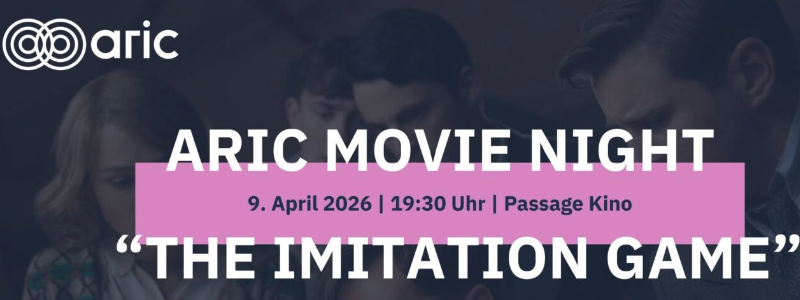
ARIC Movie Night | The Imitation Game
Am 9. April 2026 findet die nächste ARIC Movie Night statt. Wir schauen The Imitation Game und diskutieren anschließend über Fragen wie: Was bedeutet der Turing Test in Zeiten von modernen LLMs? Wie inklusiv ist die Entwicklung von KI-Modellen heute? Sowie die vielen weiteren Anknüpfungspunkte, die der Film bietet.
The Imitation Game (2014) basiert auf der Geschichte von Alan Turing, Mitbegründer der Informatik und mit dem Turing-Test Vordenker im Bereich KI. Das Drama gewann den Oscar für das beste adaptierte Drehbuch sowie den Publikumspreis beim Toronto International Film Festival.
Turing war Logiker, Mathematiker, Informatiker und Kryptoanalytiker und forschte während des zweiten Weltkriegs in Bletchley Park, der britischen militärischen Stelle, die sich im Zweiten Weltkrieg mit der Entzifferung des deutschen Nachrichtenverkehrs befasste. Es gelang ihm durch seine Turingmachine, die deutschen Funksprüche zu entschlüsseln. Die Turingmachine gilt heute als wegweisend für die Entwicklung der KI. Sie ist ein Gedankenmodell, das beschreibt, was ein Algorithmus ist und die Grenzen aufzeigt, was berechenbar ist und, was nicht.
Institutions
- Artificial Intelligence Center Hamburg (ARIC) e.V.
Artificial Intelligence as Philosophical Disruption: Understanding Human-Technology Relations after the Digital Revolution
The impact of artificial intelligence on society is so profound that it can be considered to be disruptive. AI does not only have radical consequences for society - as is expressed by the concept of ‘the Fourth Revolution’ and ‘Society 5.0’ that is emerging from that - but also for ethics itself. Technologies have become ethically disruptive, in the sense that they challenge and affect the very concepts with which we can do ethics in the first place. What do’ agency’, ‘responsibility’ and ‘empathy’ mean when artificial agents are entering society? What does ‘democratic representation’ mean when AI systems interfere with the very idea of representation itself? What can the notion of ‘the humane’ still mean when AI systems become an intrinsic part of human actions and decision-making? This talk will explore phenomenon of ethical disruption in detail, by investigating the various ways in which technologies – and not only human beings – can be ethically significant. Breaking the human monopoly on ethics and expanding it towards technology will make it possible to connect ethics more directly to practices of design. The resulting ‘Guidance Ethics Approach’ enables bottom-up ethical reflection that can foster the responsible design, implementation and use of new and emerging technologies.
Prof. Dr. Peter-Paul Verbeek (Universiteit van Amsterdam, NL)
Peter-Paul Verbeek (1970) is Rector Magnificus and professor of Philosophy and Ethics of Science and Technology at the University of Amsterdam. His research and teaching focus on the relationship between humans and technology, viewed from an ethical perspective and in close relation to design. He is chair of the UNESCO World Commission for the Ethics of Science and Technology (COMEST), editor-in-chief of the Journal of Human-Technology Relations, and editor of the Lexington book series in Postphenomenology and the Philosophy of Technology. More information: www.ppverbeek.nl
Institutions
- UHH

Assessing Human and Algorithmic Methods in Content Moderation under the DSA - NAIL Research Seminar #17
Professor Christoph Kumpan and Professor Georg Ringe would like to invite you to the NAIL Research Seminar #17 with Ass. Prof. David Restrepo Amariles (HEC Paris). The event will be held in English and will take place in person. You can also participate online by registering your participation via mail.
The Digital Services Act (DSA) of the European Union targets content moderation challenges, such as the dissemination of illegal content and disinformation, which are recognized as systemic risks. This presentation delves into the effectiveness of algorithms and crowdsourced moderation in meeting the obligations of Very Large Online Platforms (VLOPs) under the DSA concerning content moderation. Specifically, it examines the propagation of disinformation via X and evaluates the effectiveness of both human and algorithmic aspects of its content moderation processes, particularly Community Notes, on the spread of such content. We have created a dataset of Community Notes and corresponding tweet data since September 2023 to analyze content moderation and tweet diffusion. Employing topic modeling and a difference-in-difference methodology, the research quantifies the impact of Community Notes on tweet diffusion, demonstrating a significant reduction. Despite the observed effectiveness, the study highlights the need for enhanced content moderation strategies to address the rapid spread of misinformation. The findings of this study are pertinent for understanding the collaboration required among legal, technological, and regulatory stakeholders to uphold the DSA.
Institutions
- Network for Artificial Intelligence and Law (NAIL)

Ausstellungseröffnung: Can you hear it? Musik und künstliche Intelligenz
Im digitalen Zeitalter ist die Künstliche Intelligenz (KI) ein zentrales Diskussionsthema. Welche Chancen bietet KI, welche Gefahren birgt sie? Und wie funktioniert sie überhaupt? Können Algorithmen die menschliche Kreativität ersetzen oder sogar übertreffen? Diese Fragen stellt die Ausstellung „Can You Hear It? Musik und Künstliche Intelligenz” im MK&G und präsentiert verschiedene Anwendungen von KI auf dem Gebiet der Musik. Das Spektrum der Themen ist vielfältig und reicht von dem Einsatz der KI in Streamingdiensten über Emotionalität in der Filmmusik, neue Erkenntnisse der Musikethnologie und der Instrumentenakustik bis hin zu Hip-Hop als politisches und globalisiertes Phänomen. Die Besucher*innen können die multimedialen und interaktiven Stationen der facettenreichen Ausstellung auf spielerische Weise erkunden.
Die Ausstellung ist eine Kooperation des MK&G mit dem Institut für Systematische Musikwissenschaft der Universität Hamburg sowie Musicube, Elbsilber und Ohrfilm. Mit freundlicher Unterstützung der Volkswagenstiftung, der Körber-Stiftung und der Merck Finck Stiftung.
Institutions
- Institut für Systematische Musikwissenschaft der Universität Hamburg
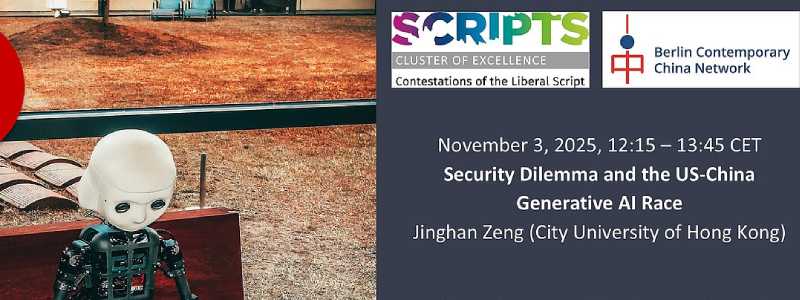
BCCN Lecture Series: AI Governance in China
Jeffrey Ding (George Washington University): Reputation Collectives: How International Industry Associations Influence China's Safety Standards in High-Risk Technologies
Artificial intelligence is rapidly transforming societies, economies, and political systems worldwide, and China is emerging as a central actor in shaping the governance of these technologies. This lecture series explores the multiple dimensions of AI governance in China, from state regulation and the role of AI in public administration to societal engagement with AI technologies.
The lectures highlight how China’s AI ambitions intersect with broader global trends and geopolitical tensions. The rise of generative AI has intensified the U.S.–China technological and strategic competition, introducing new complexities to the traditional security dilemma. At the same time, Chinese efforts to regulate and promote AI domestically reflect broader concerns over economic competitiveness, social stability, and regime security. The BCCN lecture series shed light on how AI is reshaping power relations, technological competition, and everyday life.
Join us online and in person for six lectures featuring leading scholars, including: Jinghan Zeng (City University of Hong Kong), Hui Zhou and Genia Kostka (Freie Universität Berlin) and Angela Huyue Zhang (USC Gould School of Law), Eddie Yang (Purdue University), David Yang (Harvard University) and Jeffrey Ding (George Washington University).
Hosted by the Berlin Contemporary China Network (BCCN), the China Competence Training Center (CCTC) and SCRIPTS, the 2025/26 winter term lecture series is conceptualized by Prof. Dr. Genia Kostka and Anton Bogs from Freie Universität Berlin.
Institutions
- Institut für Asien- und Afrikawissenschaften, Humboldt-Universität zu Berlin
BCCN Lecture Series: AI Governance in China
David Y. Yang (Harvard University): Government as Venture Capitalists in AI
Artificial intelligence is rapidly transforming societies, economies, and political systems worldwide, and China is emerging as a central actor in shaping the governance of these technologies. This lecture series explores the multiple dimensions of AI governance in China, from state regulation and the role of AI in public administration to societal engagement with AI technologies.
The lectures highlight how China’s AI ambitions intersect with broader global trends and geopolitical tensions. The rise of generative AI has intensified the U.S.–China technological and strategic competition, introducing new complexities to the traditional security dilemma. At the same time, Chinese efforts to regulate and promote AI domestically reflect broader concerns over economic competitiveness, social stability, and regime security. The BCCN lecture series shed light on how AI is reshaping power relations, technological competition, and everyday life.
Join us online and in person for six lectures featuring leading scholars, including: Jinghan Zeng (City University of Hong Kong), Hui Zhou and Genia Kostka (Freie Universität Berlin) and Angela Huyue Zhang (USC Gould School of Law), Eddie Yang (Purdue University), David Yang (Harvard University) and Jeffrey Ding (George Washington University).
Hosted by the Berlin Contemporary China Network (BCCN), the China Competence Training Center (CCTC) and SCRIPTS, the 2025/26 winter term lecture series is conceptualized by Prof. Dr. Genia Kostka and Anton Bogs from Freie Universität Berlin.
Institutions
- Institut für Asien- und Afrikawissenschaften, Humboldt-Universität zu Berlin
BCCN Lecture Series: AI Governance in China
Eddie Yang (Purdue University): Propaganda is Already Influencing Large Language Models: Evidence from Training Data, Audits, and Real-world Usage
Artificial intelligence is rapidly transforming societies, economies, and political systems worldwide, and China is emerging as a central actor in shaping the governance of these technologies. This lecture series explores the multiple dimensions of AI governance in China, from state regulation and the role of AI in public administration to societal engagement with AI technologies.
The lectures highlight how China’s AI ambitions intersect with broader global trends and geopolitical tensions. The rise of generative AI has intensified the U.S.–China technological and strategic competition, introducing new complexities to the traditional security dilemma. At the same time, Chinese efforts to regulate and promote AI domestically reflect broader concerns over economic competitiveness, social stability, and regime security. The BCCN lecture series shed light on how AI is reshaping power relations, technological competition, and everyday life.
Join us online and in person for six lectures featuring leading scholars, including: Jinghan Zeng (City University of Hong Kong), Hui Zhou and Genia Kostka (Freie Universität Berlin) and Angela Huyue Zhang (USC Gould School of Law), Eddie Yang (Purdue University), David Yang (Harvard University) and Jeffrey Ding (George Washington University).
Hosted by the Berlin Contemporary China Network (BCCN), the China Competence Training Center (CCTC) and SCRIPTS, the 2025/26 winter term lecture series is conceptualized by Prof. Dr. Genia Kostka and Anton Bogs from Freie Universität Berlin.
Institutions
- Institut für Asien- und Afrikawissenschaften, Humboldt-Universität zu Berlin

Universität Hamburg
Adeline Scharfenberg