biology
Events
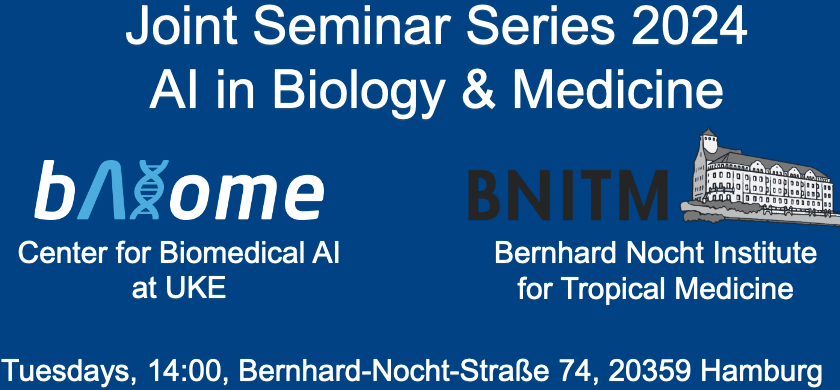
Al for biomedical imaging: computational superresolution and more - BNITM seminar series "AI in Biology and Medicine".
bAIome Center for biomedical AI (UKE) and Bernhard Nocht Institute for Tropical Medicine (BNITM) will host the seminar series entitled “AI in biology and Medicine”. This series aims to capture a broad audience and promote cross institutional collaboration. Our expert speakers will give an overview and insight into particular AI/data science methods being developed in key areas of biology and medicine. We will have drinks and snacks following each seminar to facilitate exchange.
René Werner, Institute for Applied Medical Informatics, UKE
For further details and hybrid links, please go to the webpage AI in Biology & Medicine

Biologically inspired AI: A framework for designing adaptive robots
Future robots need to be robust and adaptable, and new design approaches are needed for new production methods. I will talk about my research in using evolutionary algorithms and biologically inspired methods with the aim of having more intelligent, robust, and adaptive behavior in robots. I will give a short introduction to some of the algorithms and show how we, at the University of Oslo, apply them in our research platforms for exploring automatic robot design and adaptation. Here, we take an embodied AI approach and aim to co-design the body and the behavior of the robots, such that they are well fit for their intended environments and tasks. These approaches are still at a fundamental research stage, and I will discuss potential future application areas, as well as challenges and opportunities related to the sustainability of these AI systems.
Learning objectives:
By the end of the session, participants will be able to:
- List some bio-inspired AI approaches for robot design and adaptation.
- Discuss challenges and opportunities related to algorithmic robot design.
Recommended mastery level:
- Some undergraduate level engineering or computer science skills would be beneficial, although not absolutely necessary.
Institution
- AI for Good
Computational pathology: The gap between research and clinics - BNITM seminar series "AI in Biology and Medicine".
bAIome Center for biomedical AI (UKE) and Bernhard Nocht Institute for Tropical Medicine (BNITM) will host the seminar series entitled “AI in biology and Medicine”. This series aims to capture a broad audience and promote cross institutional collaboration. Our expert speakers will give an overview and insight into particular AI/data science methods being developed in key areas of biology and medicine. We will have drinks and snacks following each seminar to facilitate exchange.
Marina Zimmermann, professor of computational pathology (UKE) will speak about the gap between research and clinics and the factors that contribute to this, such as the focus on reproducing subjective scores and the large variance in performance depending on the data source. She will look into overcoming subjective scores by introducing objective endpoints, as well as developing quantifiable and objective metrics based on specialised microscopy types. In order to further close the gap, she will address domain shifts between datasets and generalizability, as well as measures of uncertainty to defer uncertain decisions.
A hybrid option will be provided using the following link: https://us02web.zoom.us/j/87481976655?pwd=NytjVFVXaUJIN1hVSW91aFNSSGRSUT09
Meeting-ID: 874 8197 6655
Kenncode: 097471
Machine learning of MCMV infection dynamics - BNITM seminar series "AI in Biology and Medicine".
bAIome Center for biomedical AI (UKE) and Bernhard Nocht Institute for Tropical Medicine (BNITM) will host the seminar series entitled “AI in biology and Medicine”. This series aims to capture a broad audience and promote cross institutional collaboration. Our expert speakers will give an overview and insight into particular AI/data science methods being developed in key areas of biology and medicine. We will have drinks and snacks following each seminar to facilitate exchange.
Lorenz Adlung, I Medical Clinic and Polyclinic, UKE: Machine learning of MCMV infection dynamics
For further details and hybrid links, please go to the webpage AI in Biology & Medicine
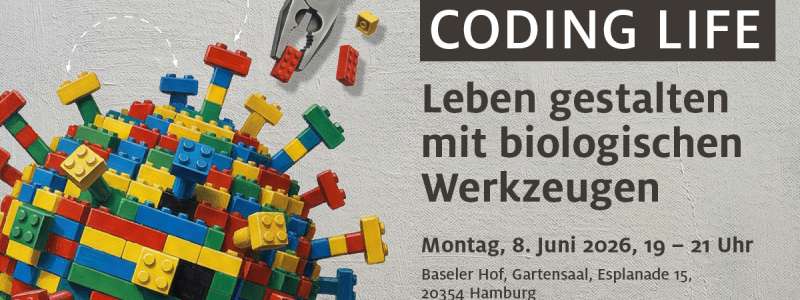
PODIUMSDISKUSSION - CODING LIFE: Leben gestalten mit biologischen Werkzeugen
Coding Life meint das Prinzip, dass Zellen wie winzige Hightech-Computer funktionieren. Sie lesen den genetischen Code, den Forschende umschreiben, ergänzen oder völlig neu erfinden. Die Fortschritte im Bereich der synthetischen Biologie sind rasant – maßgeblich vorangetrieben durch Künstliche Intelligenz. Moderne KI-Modelle können heute komplexe Proteinstrukturen innerhalb von Sekunden berechnen und sogar neue, maßgeschneiderte Proteine entwerfen. Bereits in naher Zukunft könnten sogenannte KI-Agenten den nächsten großen Effizienzsprung ermöglichen: Sie planen Experimente zunehmend eigenständig, werten Daten aus und optimieren biologische Designs – ein menschliches Eingreifen wird dabei immer seltener notwendig.
Die absehbare Automatisierung wirft Fragen auf, denen die Podiumsdiskussion nachgeht. Sie lauten etwa:
• Was dürfen wir verändern?
• Wie viel Kontrolle sollten wir autonomen KI-Systemen künftig überlassen?
• Wem gehört das maschinell generierte Wissen?
• Denken wir noch selbst oder prompten wir nur noch?
Institutions
- Akademie der Wissenschaft in Hamburg
- Centre for Structural Systems Biology (CSSB)
Predicting clinical response to treatment in inpatients with depression - BNITM seminar series "AI in Biology and Medicine".
bAIome Center for biomedical AI (UKE) and Bernhard Nocht Institute for Tropical Medicine (BNITM) will host the seminar series entitled “AI in biology and Medicine”. This series aims to capture a broad audience and promote cross institutional collaboration. Our expert speakers will give an overview and insight into particular AI/data science methods being developed in key areas of biology and medicine. We will have drinks and snacks following each seminar to facilitate exchange.
Fatemeh Hadaeghi,Institute of Computational Neuroscience, UKE
For further details and hybrid links, please go to the webpage AI in Biology & Medicine
Systems Biology of Cancer - BNITM seminar series "AI in Biology and Medicine".
bAIome Center for biomedical AI (UKE) and Bernhard Nocht Institute for Tropical Medicine (BNITM) will host the seminar series entitled “AI in biology and Medicine”. This series aims to capture a broad audience and promote cross institutional collaboration. Our expert speakers will give an overview and insight into particular AI/data science methods being developed in key areas of biology and medicine. We will have drinks and snacks following each seminar to facilitate exchange.
Angela Relógio, Medical School Hamburg MSH
For further details and hybrid links, please go to the webpage AI in Biology & Medicine
Technical foundations of Large Language Models, their applications and limitations - BNITM seminar series "AI in Biology and Medicine".
bAIome Center for biomedical AI (UKE) and Bernhard Nocht Institute for Tropical Medicine (BNITM) will host the seminar series entitled “AI in biology and Medicine”. This series aims to capture a broad audience and promote cross institutional collaboration. Our expert speakers will give an overview and insight into particular AI/data science methods being developed in key areas of biology and medicine. We will have drinks and snacks following each seminar to facilitate exchange.
Christopher Gundler, Institute for Applied Medical Informatics, UKE
For further details and hybrid links, please go to the webpage AI in Biology & Medicine
Unsupervised patient stratification based on omics data - BNITM seminar series "AI in Biology and Medicine".
bAIome Center for biomedical AI (UKE) and Bernhard Nocht Institute for Tropical Medicine (BNITM) will host the seminar series entitled “AI in biology and Medicine”. This series aims to capture a broad audience and promote cross institutional collaboration. Our expert speakers will give an overview and insight into particular AI/data science methods being developed in key areas of biology and medicine. We will have drinks and snacks following each seminar to facilitate exchange.
Olga Zolotareva, Institute for Computational Systems Biology, UHH
For further details and hybrid links, please go to the webpage AI in Biology & Medicine
Institutions
Data Science in Hamburg | Helmholtz Graduate School for the Structure of Matter, DESY & UHH & TUHH & HSU & HAW & Hereon & HZI & MPSD & EuXFEL
Helmholtz graduate school educating the next generation of international and interdisciplinary data scientists
Leibniz Institute of Virology
The Leibniz Institute of Virology (LIV) is a non-profit, independent research foundation that has been part of the Leibniz Association since 1995.
The LIV’s research is partly funded by the Federal Ministry of Health (BMG) and the combined research funding by the Länder, which is represented by Hamburg’s Ministry of Science, Research, Equality and Districts (BWFGB). Significant funding is also acquired through competitive bidding from national research programmes, private foundations and the industry.

Universität Hamburg
Adeline Scharfenberg