climate
Events

Understanding past climate events and trends to constrain near-future climate risk
The global mean surface temperature record combining sea surface and near-surface air data is central to understanding climate variability and change. Understanding the past record also helps constrain uncertainty in future climate projections. In my talk, I will present a recent study (Sippel et al., 2024, Nature, doi:10.1038/s41586-024-08230-1) that refines our view of the historical record and explore its implications for near-future climate risk.
Past temperature record: The early temperature record (before ~1950) remains uncertain due to evolving methods, limited documentation, and sparse coverage. Independent reconstructions show that historical ocean temperatures were likely measured too cold by about 0.26 °C compared to land estimates despite strong agreement in other periods. This cold bias cannot be explained by natural variability; multiple lines of evidence (climate attribution, timescale analysis, coastal data, palaeoclimate records) support a substantial cold bias in early ocean records. While overall warming since the mid-19th century is unchanged, correcting the bias reduces early-20th-century warming trends, lowers global decadal variability, and brings models and observations into closer alignment.
Constraining climate risk: I will close my talk by discussing how these findings sharpen near-future temperature projections and our understanding of climate risk; and furthermore how new AI methods may provide an even clearer picture of past climate and near-future climate risk.
Institutions
- AI for Good
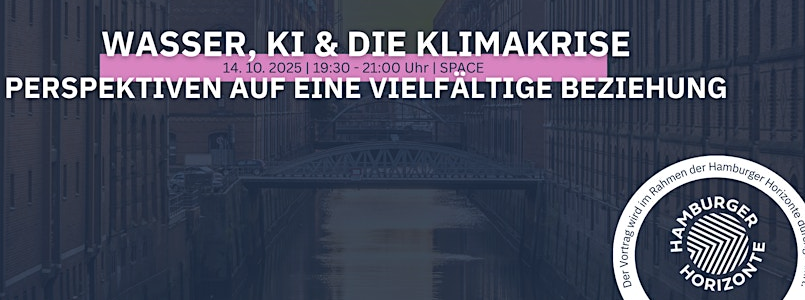
Wasser, KI und die Klimakrise – Perspektiven auf eine vielfältige Beziehung
Anselm Fehnker, Senior AI Projektmanager am Artificial Intelligence Center Hamburg (ARIC) e.V.
Louisa Rockstedt, Projektmanagerin am Artificial Intelligence Center Hamburg (ARIC) e.V.
Künstliche Intelligenz gilt als Schlüsseltechnologie der Zukunft. Doch was kann sie beitragen, wenn es um eines unserer wichtigsten und zugleich am stärksten bedrohten Güter, dem Wasser, geht? Und worauf müssen wir achten, um technologische Innovation mit ökologischer Verantwortung zu verbinden?
In diesem Vortrag werfen wir einen Blick auf die Schnittstelle zwischen KI, Wasser und Klimakrise. Anhand konkreter Beispiele aus Forschung und Praxis beleuchten wir verschiedene Perspektiven: Wie kann KI helfen, Überschwemmungen, Dürren und Wasserverschmutzung frühzeitig zu erkennen? Können smarte Technologien zur effizienteren Nutzung und Einsparung von Wasser beitragen? Und welche Risiken bringt KI selbst für Umwelt und Wasser mit sich?
Wir freuen uns darauf, mit euch im schönen Ambiente der Speicherstadt sowohl die Potenziale als auch die Herausforderungen von KI im Kontext der ökologischen Transformation zu reflektieren und gemeinsam zu diskutieren.
Institutions
- Hamburger Horizonte sind eine Initiative von Körber Stiftung, HIAS, UHH

Universität Hamburg
Adeline Scharfenberg