data analytics
Events
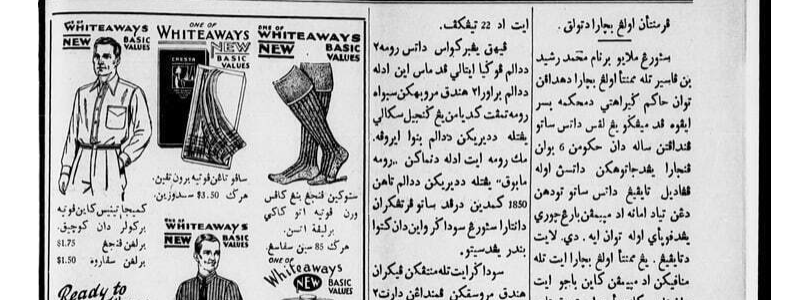
Lecture (in-site): "Towards machine-readable Jawi Newspapers using bespoke AI models"
In the century between the 1870s and the 1970s, hundreds of Malay-language periodicals circulated around the Malay-speaking world. These periodicals chronicle a fascinating era and have been the focus of intense study by scholars such as William Roff and Ian Proudfoot. Many of these periodicals have been digitized, and comprehensive collections are at the National Library of Singapore, as well as in other libraries and archives.
Given the availability and size of the collections, the opportunity is ripe for systematic digital analysis. Projects elsewhere in the world have demonstrated the power of analysing historical newspapers at scale using computational methods. Examples include "Living With Machines" (a partnership between the British Library and several universities in the UK) and "Oceanic Exchanges" (a partnership between Finland, Germany, Mexico, the Netherlands, the United Kingdom, and the United States).
What is holding back a similar study of Malay-language newspapers?
– The main obstacle is the script. The majority of these periodicals were published in Jawi, an adaptation of the Perso-Arabic script for the Malay language, which poses significant challenges for digital processing. For one thing, typical Optical Character Recognition pipelines (OCR) don't work well for Jawi.
– Another challenge is that most contemporary Malay readers, including many historians who would be interested in these collections, are less familiar with Jawi than with Rumi (the Romanized version of Malay most commonly used today). The automatic transliteration from Jawi to Rumi is also a complex task, as vowels are often not marked down in Jawi.
– In addition to this, spelling conventions have changed, and there are many different approaches for transliterating the same word.
To address these challenges, the "Computational Heritage" research group at the National University of Singapore has developed specialized AI models for both Jawi OCR and Jawi-to-Rumi transliteration. In this talk, I will describe our progress so far, the challenges we still face and the future directions of our work.
Institutions
- Department for Languages and Cultures of Southeast Asia, Asia-Africa-Institute (AAI), UHH

Lecture Series: Business Analytics und Data Science
Learning to Optimize: How Machine Learning Drives Decisions at Companies like Uber
Have you ever wondered why and where taxi cars wait, or how smart Uber drivers make their decisions? This talk will delve into these intriguing questions. We will explore the concept of sequential decision-making and policy classes through a hands-on approach. Using taxi services as an example, we learn how service providers can optimize their decision-making. And guess what? There´s not as much magic behind it as you might think...so prepare to be surprised!
Distinguished Lecture Series in Business Analytics & Data Science
The Distinguished Lecture Series in Business Analytics & Data Science at Kühne Logistics University (KLU) presents public lectures on selected topics in analytics, data science, and their applications across various industries, including logistics and supply chain management. Targeted at students, alumni, industry professionals, and other interested individuals, the series offers insights into the latest advancements, trends, and challenges in these fields. Attendees gain valuable knowledge on how data-driven decision-making can transform business operations and enhance efficiency in today's digital economy.
Institution
- Kühne Logistics University (KLU)
Lecture Series: Business Analytics und Data Science - "Business Analysis without Data"
This talk explores analytic methods that prioritize theory over pure data accumulation. It deep dives into game theory by dissecting the principal-agent model to reveal hidden strategic dynamics. Ultimately, the presentation underscores that thoughtful analysis provides robust decision-making tools where data is scarce. Attendees gain valuable knowledge on how data-driven decision-making can transform business operations and enhance efficiency in today's digital economy.
Event free of charge, register here
Distinguished Lecture Series in Business Analytics & Data Science
The Distinguished Lecture Series in Business Analytics & Data Science at Kühne Logistics University (KLU) presents public lectures on selected topics in analytics, data science, and their applications across various industries, including logistics and supply chain management. Targeted at students, alumni, industry professionals, and other interested individuals, the series offers insights into the latest advancements, trends, and challenges in these fields. Attendees gain valuable knowledge on how data-driven decision-making can transform business operations and enhance efficiency in today's digital economy.
Institutions
- Kühne Logistics University (KLU)
Lectures Series: AI-Enhanced Life: Empowering Your Personal and Professional Journey Through Generative AI
Distinguished Lecture Series in Business Analytics and Data Science
The Distinguished Lecture Series in Business Analytics & Data Science at Kühne Logistics University (KLU) presents public lectures on selected topics in analytics, data science, and their applications across various industries, including logistics and supply chain management. Targeted at students, alumni, industry professionals, and other interested individuals, the series offers insights into the latest advancements, trends, and challenges in these fields. Attendees gain valuable knowledge on how data-driven decision-making can transform business operations and enhance efficiency in today's digital economy.
"AI-Enhanced Life: Empowering Your Personal and Professional Journey Through Generative AI”
Generative AI is advancing at such a rapid pace that it can be difficult to keep up. New tools, features, and opportunities are emerging almost daily, opening up a world of possibilities. In this talk, we will explore how AI is no longer just a tool for efficiency, but a catalyst for creativity, decision-making, and personal growth. We will dive into the ways Generative AI can enhance individual potential by helping people unlock new levels of productivity, streamline everyday tasks, and fuel innovation in the workplace. In the professional realm, we will discuss how AI-driven insights are transforming industries, allowing for more agile business strategies and improved collaboration between humans and machines. By examining real-world use cases and offering practical insights, this talk will equip you with the knowledge to embrace AI in your own journey.
Event free of charge, Register now!
Institution
- Kühne Logistics University (KLU)
Lectures Series: Optimisation for the Masses: No-Code, No-Math Modelling of Decision Problems
Distinguished Lecture Series in Business Analytics & Data Science
The Distinguished Lecture Series in Business Analytics & Data Science at Kühne Logistics University (KLU) presents public lectures on selected topics in analytics, data science, and their applications across various industries, including logistics and supply chain management. Targeted at students, alumni, industry professionals, and other interested individuals, the series offers insights into the latest advancements, trends, and challenges in these fields. Attendees gain valuable knowledge on how data-driven decision-making can transform business operations and enhance efficiency in today's digital economy.
Optimisation for the Masses: No-Code, No-Math Modelling of Decision Problems
Despite significant advancements in optimisation algorithms, their application remains limited to a narrow range of decision problems within businesses and organisations. Contributing to this gap between algorithmic innovation and practical usage is the complexity of translating real-world constraints into mathematical models required in order to be able to apply off-the-shelf optimisation solvers. Developing custom-made optimisation algorithms, as an alternative, demands substantial upfront investment and ongoing maintenance to ensure compatibility with evolving business needs. If such maintenance and adjustments are not done continuously, a significant technical debt can accumulate weakening overall competitiveness. This presentation shows how domain experts without expertise in mathematical modelling or programming can formulate and maintain decision problems graphically, providing all the information that is needed to apply algorithms for solving respective optimisation problems.
Event free of charge, Register now!
Institution
- Kühne Logistics University (KLU)
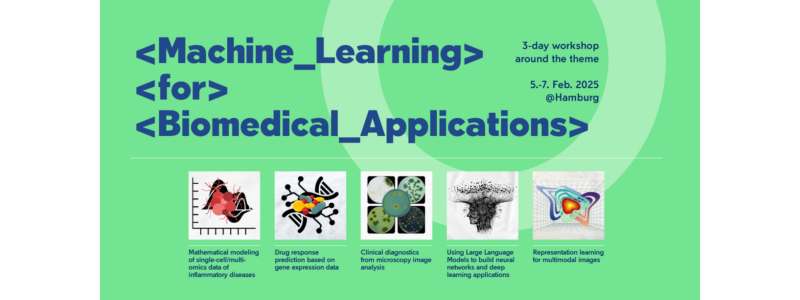
Machine Learning for Biomedical Applications- International EUGLOH Workshop in Hamburg
learn_bAIome offers workshops and trainings in biomedical AI/data science with tailored formats that take into account background, programming skills and intensity to provide unique, focused, and effective courses. These courses are free and open to students, clinicians, and researchers across academic institutions in Hamburg.
Prerequisites: Intermediate level computational background and basic knowledge of machine learning
Description: This 3-day international workshop is organised by University of Hamburg’s European University Alliance for Global Health (EUGLOH), Hub of Computing and Data Science (HCDS) and Center for Biomedical AI at UKE (bAIome) to foster international exchange and cooperation among students and researchers working in machine learning relating to biomedical questions. The vision is to create a supportive network and inspire international collaborations.
The workshop will explore various aspects of machine learning using biomedical data with the hands-on practical projects providing the main focus, allowing participants to work in a team environment to understand how machine learning is applied to specific biomedical challenges.
For further details and registration check out the EUGLOH website

Machine Learning in Practice (intermediate level)
learn_bAIome offers workshops and trainings in biomedical AI/data science with tailored formats that take into account background, programming skills and intensity to provide unique, focused, and effective courses. These courses are free and open to students, clinicians, and researchers across academic institutions in Hamburg.
This workshop is open to students, researchers, and clinicians wanting to learn how machine learning is applied for biomedical datasets, the different classes of machine learning algorithms that may be used, as well as the best practices in selecting and evaluating algorithms, and their limitations. The aim of the course is to provide concepts and tools to navigate the use of machine learning in the biomedical landscape. The course will use biological datasets and there will be hands-on components as well as discussions. Participants should already have taken an introduction to machine learning and be familiar with Python programming. The workshop will be in presence and therefore each participant should bring their own laptop (no ipads).
Topics
- Taxonomy of machine learning algorithms
- Linear regression, logistic regression and related methods
- Decision trees
- Support Vector Machines
- Bias & Variance, curse of dimensionality
- Representation learning
- Neural networks and deep learning: MLPs, transformers, CNNs
- Applications to RNAseq and imaging data
Mini Symposium: next-gen biomedical AI- new developments & applications
Whether you have a background in computer science, or biomedical-related fields, this Mini Symposium is designed to be very inclusive for students, researchers, and clinicians working and/or interested in biomedical AI. Our invited speakers will provide engaging presentations that introduce core ideas in AI and demonstrate how they are being applied to solve challenges in biomedicine. There will be opportunities for short lightning talks, Q&A, and networking, all in a fun and relaxed atmosphere with drinks and snacks provided. Please register for this event here.
Invited speakers Fabian Kern (UHH) and Fatemeh Haedaghi (UKE) will give talks on new developments in their research. See titles and abstracts here.
Lightning talks: Interested in giving a short talk about your current research? Let us know in your registration. There will be a number of short talks from selected topics to give exciting impulses of cutting-edge research as well as plenty of time and encouragement of audience participation.
Topics of interest:
- Application of AI in diagnostics (omics, pathology, radiology)
- Predictive modeling for patient outcomes
- Drug discovery and personalized medicine
- Foundation models in biomedicine
- Federated learning and data privacy in biomedicine
- Explainable AI and model interpretability

Taking Responsibility for Someone Else's Code: Studying the Privacy Behaviors of Mobile Apps at Scale
Abstract: Modern software development has embraced the concept of "code reuse," which is the practice of relying on third-party code to avoid "reinventing the wheel" (and rightly so). While this practice saves developers time and effort, it also creates liabilities: the resulting app may behave in ways that the app developer does not anticipate. This can cause very serious issues for privacy compliance: while an app developer did not write all of the code in their app, they are nonetheless responsible for it. In this talk, I will present research that my group has conducted to automatically examine the privacy behaviors of mobile apps vis-à-vis their compliance with privacy regulations. Using analysis tools that we developed and commercialized (as AppCensus, Inc.), we have performed dynamic analysis on hundreds of thousands of the most popular Android apps to examine what data they access, with whom they share it, and how these practices comport with various privacy regulations, app privacy policies, and platform policies. We find that while potential violations abound, many of the issues appear to be due to the (mis)use of third-party SDKs (i.e., supply chain problems). I will provide an account of the most common types of privacy and security issues that we observe and how app developers can better identify these issues prior to releasing their apps.
Bio: Serge Egelman
Institutions
- Fachbereich Informatik, Universität Hamburg
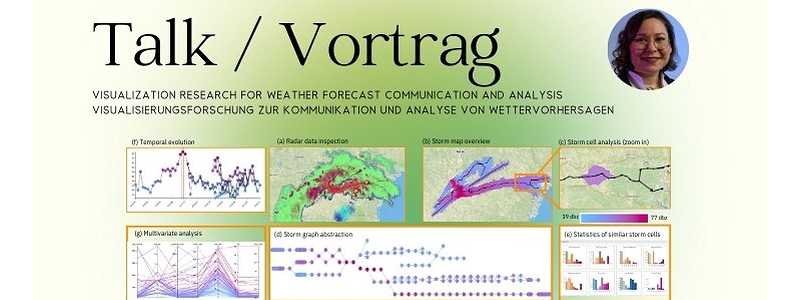
Talk by Alexandra Diehl on Weather Forecast Communication and Analysis
We are excited to announce a guest talk by Alexandra Diehl from the University of Zurich, who will present her latest research on the visualization and communication of weather forecasts. Alexandra is a senior researcher and lecturer in the Multimedia and Visualization group at UZH's Department of Computer Science. Her work focuses on efficient analysis, decision-making, and communication of high-impact weather events (HIWE) and their associated risks.
Talk Title: Visualization Research for Weather Forecast Communication and Analysis
Abstract: This talk will cover Alexandra's recent contributions to developing efficient visualization tools for analyzing and communicating weather forecasts and characterizing HIWEs. Additionally, she will discuss her current efforts in citizen data analysis and the challenges of effectively communicating severe weather events through participatory citizen science.
Speaker Bio: Alexandra Diehl holds a Ph.D. in Computer Science from the University of Buenos Aires and has extensive experience in data visualization, visual analytics, and geographic information systems. She has been a postdoctoral researcher in the Data Visualization and Analysis Group at the University of Konstanz and currently works with Prof. Dr. Renato Pajarola's group at UZH.
We look forward to seeing many of you at this insightful talk.

Universität Hamburg
Adeline Scharfenberg