big data
Events
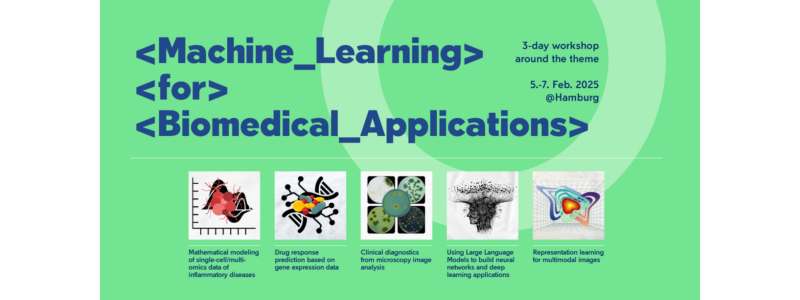
Machine Learning for Biomedical Applications- International EUGLOH Workshop in Hamburg
learn_bAIome offers workshops and trainings in biomedical AI/data science with tailored formats that take into account background, programming skills and intensity to provide unique, focused, and effective courses. These courses are free and open to students, clinicians, and researchers across academic institutions in Hamburg.
Prerequisites: Intermediate level computational background and basic knowledge of machine learning
Description: This 3-day international workshop is organised by University of Hamburg’s European University Alliance for Global Health (EUGLOH), Hub of Computing and Data Science (HCDS) and Center for Biomedical AI at UKE (bAIome) to foster international exchange and cooperation among students and researchers working in machine learning relating to biomedical questions. The vision is to create a supportive network and inspire international collaborations.
The workshop will explore various aspects of machine learning using biomedical data with the hands-on practical projects providing the main focus, allowing participants to work in a team environment to understand how machine learning is applied to specific biomedical challenges.
For further details and registration check out the EUGLOH website
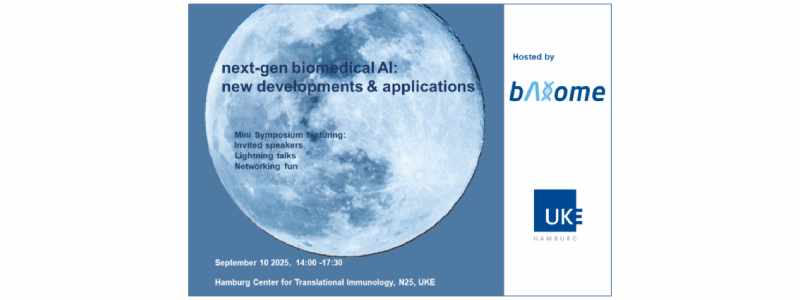
Mini Symposium: next-gen biomedical AI- new developments & applications
Whether you have a background in computer science, or biomedical-related fields, this Mini Symposium is designed to be very inclusive for students, researchers, and clinicians working and/or interested in biomedical AI. Our invited speakers will provide engaging presentations that introduce core ideas in AI and demonstrate how they are being applied to solve challenges in biomedicine. There will be opportunities for short lightning talks, Q&A, and networking, all in a fun and relaxed atmosphere with drinks and snacks provided. Please register for this event here.
Invited speakers Fabian Kern (UHH) and Fatemeh Haedaghi (UKE) will give talks on new developments in their research. See titles and abstracts here.
Lightning talks: Interested in giving a short talk about your current research? Let us know in your registration. There will be a number of short talks from selected topics to give exciting impulses of cutting-edge research as well as plenty of time and encouragement of audience participation.
Topics of interest:
- Application of AI in diagnostics (omics, pathology, radiology)
- Predictive modeling for patient outcomes
- Drug discovery and personalized medicine
- Foundation models in biomedicine
- Federated learning and data privacy in biomedicine
- Explainable AI and model interpretability
TRR 181 Seminar Series: November 6, Rupert Klein (FU Berlin): Thoughts on Machine Learning
Techniques of machine learning (ML) find a rapidly increasing range of applications touching upon social, economic, and technological aspects of everyday life. They are also being used with great enthusiasm to fill in gaps in our scientific knowledge by data-based modelling approaches. I have followed these developments for a while with interest, concern, and mounting disappointment. When these technologies are employed to take over decisive functionality in safety-critical applications, we would like to exactly know how to guarantee their compliance with pre-defined guardrails and limitations. Moreover, when they are utilized as building blocks in scientific research, it would violate scientific standards -in my opinion- if these building blocks were used without a throrough understanding of their functionality, including inaccuracies, uncertainties, and other pitfalls. In this context, I will juxtapose (a subset of) deep neural network methods with the family of entropy-optimal Sparse Probabilistic Approximation (sSPA) techniques developed recently by Illia Horenko (RPTU Kaiserslautern-Landau) and colleagues.
Institution
- Center for Earth System Research and Sustainability (CEN)

Universität Hamburg
Adeline Scharfenberg