large language models
Events
Hands-on-Workshop: KI – wie geht das? Hintergründe und Prompting in der Praxis
Prof. Dr. Heike Zinsmeister (Institut für Germanistik)
GPT und andere KI-Modelle lernen aus großen Textmengen und sind daher stark durch ihre Trainingsdaten geprägt. Darauf aufbauende Chatbots wie UHHGPT übernehmen Stereotype aus den zugrunde liegenden Modellen. In diesem 90-minütigen Workshop wird zunächst ein kurzer Blick hinter die Kulissen von KI-Modellen und Chatbots geworfen: Wie wird sprachliches Wissen in den Modellen kodiert? Wie entstehen sogenannte Halluzinationen? Was ist die RAG-Funktion, die über das Modell hinaus einen Echtzeitzugriff auf Informationen ermöglicht?
Im zweiten Teil können die Teilnehmenden verschiedene Prompting-Strategien selbst ausprobieren, zum Beispiel für Ideengenerierung, Recherche, Textarbeit oder Seminarplanung.
Hands-on-Workshop: Künstlich? Intelligent? gKI-Kompetenz in der Lehre
Vortrag: Felicitas John und Jean-Pascal Sopha, Büro für Digitalität in der Lehre
In diesem Workshop steigen wir in das Themenfeld der generativen Künstlichen Intelligenz in der Lehre ein. Nach dem Kennlernen von Funktionsweisen und technischen Hintergründen von gKI-Anwendungen betrachten wir die Rahmenbedingungen ihres Einsatzes an der UHH: Welche Anwendungen werden genutzt und welche Orientierungsangebote stehen zur Verfügung. Anschließend bearbeiten Sie Lehrszenarien, die einen kritisch-reflektierten Umgang Ihrer Studierenden mit gKI-Anwendungen fördern.
Bitte bringen Sie zu diesem Workshop Ihren eigenen Laptop mit.
Hands-on-Workshop: masterarbeit_final221jetztaberwirklich.doc oder wie ich lernte, Versionsverwaltung zu lieben
Dr. Jonas Müller-Laackman, Staats- und Universitätsbibliothek
Bei kreativen Arbeiten geht dem finalen Produkt in der Regel eine Vielzahl von Arbeitsversionen voraus, seien es Skizzen, Ideen, ein erster Entwurf, oder die zahlreichen Varianten an Text, die in einem Begutachtungsprozess entstehen. Um dabei nicht den Überblick zu verlieren, ist ein gutes Selbstmanagement eine wichtige Voraussetzung. Dabei kann ein Konzept aus der Softwareentwicklung helfen, das sich in einigen Disziplinen und im Forschungsdatenmanagement bereits fest etabliert hat: Die Versionskontrolle oder das “Versionieren”. Im Workshop lernen Sie zunächst die Grundlagen der Versionierung und ihre praktische Umsetzung im wissenschaftlichen Arbeiten. Anschließend werden Sie erste Schritte in der Versionierungssoftware Git gehen, die Basisfunktionen von Git erlernen, und erfahren, wie man Git allein oder mit Kolleg:innen zur Zusammenarbeit nutzen kann. Ziel des Workshops ist es, eine theoretische und praktische Grundlage zu entwickeln, die bereits im Alltag eingesetzt werden kann. Darüber hinaus ist es möglich, weitergehende Perspektiven auf fortgeschrittene Funktionen wie Branches, Forks und den Umgang mit Konflikten zu erhalten. Technische Vorkenntnisse sind nicht vonnöten. Bitte bringen Sie Ihren eigenen Laptop mit, auf dem Sie zuvor Git (https://git-scm.com/downloads) installiert haben. Ein Zugang zum GitLab (https://gitlab.rrz.uni-hamburg.de/) der UHH sollte zudem bestehen.
Hands-on-Workshop: Qualitative Inhaltsanalyse mit der Discourse Analysis Tool Suite (DATS)
Tim Fischer, Julia Pawlowski (Hub of Computing and Data Science)
Die qualitative Inhalts- und Diskursanalyse von umfangreichen oder multimodalen Datenmengen stellt Forschende oft vor methodische und zeitliche Herausforderungen. In diesem Workshop erproben wir die Arbeit mit der Discourse Analysis Tool Suite (DATS), einer frei verfügbaren, KI-gestützten Open-Source-Webanwendung, die das HCDS speziell für diese Zwecke entwickelt hat.
Im Workshop durchlaufen wir gemeinsam den typischen Workflow eines qualitativen Forschungsprojekts: Wir schauen uns an, wie DATS unterschiedlichste Datenformate (Text, Bild, Audio und Video) verarbeiten und durch automatisierte Vorverarbeitung – wie etwa automatische Transkription, Bild-Captioning oder Objekterkennung – anreichern kann. Anschließend testen wir die KI-gestützte Annotation und Kategorisierung von Texten, die semantische Suche über verschiedene Medien hinweg sowie die visuelle Interpretation der Ergebnisse auf interaktiven Whiteboards.
Technische Vorkenntnisse, Erfahrungen mit Machine Learning oder eine vorherige Software-Installation sind nicht nötig, da DATS im Browser läuft. Ziel des Workshops ist es, einen ersten praxisnahen „Hands-on“-Eindruck zu vermitteln, sodass Sie DATS im Anschluss direkt für Ihre eigenen Forschungsprojekte nutzen können.
Hands-on-Workshop: Quantitative Textanalyse großer Korpora: Ein Grundlagen-Workshop zu Methoden der Stilometrie
Gastworkshop mit Prof. Dr. Julian Schröter, LMU München
Der anwendungsorientierte Workshop führt mit der Bibliothek „Stylo“ in „R“ sowie anhand ausgewählter Korpora von Novellen des 19. Jahrhunderts und Heftromanen des 20. Jahrhunderts in die stilometrische Korpusanalyse ein. Er richtet sich an Interessierte aus geistes-, kultur- und sozialwissenschaftlichen Fächern. Technische Vorkenntnisse sind nicht erforderlich, aber kein Nachteil! Im Mittelpunkt stehen praxisorientierte Gruppenarbeiten, in denen literaturwissenschaftliche Fragestellungen – etwa zur stilistischen Vorbildfunktion einzelner Werke – explorativ untersucht werden. Ein theoretischer Impuls verknüpft Stilometrie als quantitatives Verfahren mit hermeneutischen Ansätzen und erläutert ihre methodischen Grundlagen. Die Textkorpora werden bereitgestellt, für die Teilnahme ist ein Zugang zum JupyterLab der UHH (https://code.min.uni-hamburg.de/hub; mit üblicher B-Kennung nutzbar) vonnöten. Sollten Sie Schwierigkeiten mit dem Login haben oder eine Kurzzeitkennung für den Zugang benötigen, melden Sie sich bitte rechtzeitig im Vorfeld bei digitale.gw@uni-hamburg.de
Hands-on-Workshop: Research Data Management with Machine Training Support
Presentation: Prof. Dr. Ralf Möller, Institute of Humanities-Centered Artificial Intelligence (in English)
The presentation explains how research data within the Cluster of Excellence Understanding Written Artefacts (UWA) is managed and published via the University of Hamburg’s Research Data Repository (RDR). Researchers are encouraged not just to upload files but to present their data in ways that make it transparent, reusable, and compliant with FAIR (Findable, Accessible, Interoperable, Reusable) principles. A key tool in this work are CSMC files, archive packages similar to DOCX, which include project-specific views of the data. These CSMC files can be submitted to RDR, where they receive persistent identifiers (DOIs) and become accessible online. Examples from UWA projects illustrate how datasets appear in the repository with customized views rather than simple directory listings. A CSMC App also allows scholars to view and interact with their data locally, even without internet access. When a dataset is submitted, RDR automatically generates a “View Data” button so anyone can see the data presentation defined by the creators. Individual data records within these datasets can be cited directly using fragment identifiers in DOIs. The page highlights the importance of data persistence and versioning in making scholarly research reproducible and citable. Furthermore, we discuss research data from RDR and visualized as described above can be made available for fine-tuning generalized pretrained transformers to easier carry out humanities research tasks.
Hinweis: Diese Veranstaltung findet auf Englisch statt.
Hands-on-Workshop: Texte und Sprache empirisch erforschen: ein Frühstück mit Sketch Engine
Prof. Dr. Edyta Jurkiewicz-Rohrbacher, Institut für Slavistik
Frühstücken und dabei Sketch Engine kennen lernen – ein einfach zu bedienendes Werkzeug, das sich besonders gut für die Analyse großer Textmengen eignet, beispielsweise in der Linguistik, Literaturwissenschaft oder Geschichtswissenschaft. Die Analysen, die auf der Häufigkeit von Lemmata und Wortformen basieren, erlauben es, typische Ausdrücke für bestimmte Texte oder ihre Autorschaft zu entdecken. Der Workshop soll einen leichten Einstieg in die Arbeit mit Sketch Engine ermöglichen und einen Überblick über dessen Funktionalitäten geben. Sketch Engine kann von Studierenden und Mitarbeitenden der Universität Hamburg kostenlos genutzt werden.
Vorbereitung (fakultativ): Zusätzlich zu den Knabbereien kann eine Sammlung von Texten in elektronischem Format (z. B. .txt, .docx, .pdf), die man in eigener Forschung oder eigenem Studium nutzt, mitgebracht werden. Es können zum Beispiel die gesammelten Werke eines Autors, eigene oder studentische Hausarbeiten oder Webadressen von Artikeln zu einem für Teilnehmende relevanten Thema sein. Bitte bringen Sie Ihren eigenen Laptop mit. Für Kaffee und Tee wird gesorgt!
KI-Forum: AI in Healthcare
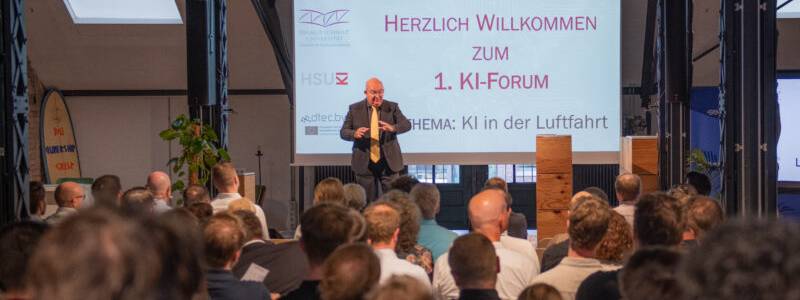
Künstliche Intelligenz (KI) ist eine der zentralen Technologien unserer Zeit. Um den interdisziplinären Austausch und die Sichtbarkeit der KI-Forschung zu stärken, lädt das KI-Institut der Helmut-Schmidt-Universität / Universität der Bundeswehr (HSU) zu einem regelmäßigen KI-Forum ein – eine Plattform für spannende Keynotes, Einblicke in aktuelle Forschungsprojekte und inspirierende Vernetzung.
WAS ERWARTET SIE?
• Keynote von führenden Expert:innen aus Industrie oder Wissenschaft zu aktuellen Themen der Künstlichen Intelligenz
• Kurzpitches von Promovierenden mit innovativen Forschungsprojekten
• Postersession & Get-Together, um mit Forschenden, Entwickelnden und Interessierten in den Austausch zu treten
FÜR WEN IST DAS KI-FORUM?
• Forschende und Lehrende mit Interesse an KI
• Unternehmen & Start-ups im KI-Bereich
• Entwickler:innen und Technologie-Expert:innen
• Alle, die sich mit KI vernetzen und inspirieren lassen möchten
KI, wie geht das? Prompt‐a‐thon zu generativer KI in Forschung und Lehre
Prof. Dr. Heike Zinsmeister, Institut für Germanistik
Unter dem Motto „KI, wie geht das?“ bieten wir für alle Interessierten eine Einführung in die Funktionsweise von Large Language Models (LLMs) wie ChatGPT und Co. Anschließend werden wir UHHGPT gemeinsam ausprobieren und den Einsatz anhand von konkreten Szenarien für die geisteswissenschaftliche Lehre, das Studium und die Forschung erkunden. Technische Vorkenntnisse sind nicht notwendig, bitte bringen Sie Ihren eigenen Laptop mit.
Anmeldung an: digitale.gw@uni-hamburg.de

LLMs & Agents in Fundamental Physics & Mathematics
Programm
- 09:00 → 09:15 Welcome & Intro 15m / Sprecher: Gregor Kasieczka (Universität Hamburg)
- 09:15 → 09:45 Best Practices / Guidelines / UHH Rules (HCDS, TBC) 30m
- 09:45 → 10:50 Usage examples (short contributed talks) 1 h 5m
- 10:50 → 11:20 Coffee Break 30m
- 11:20 → 12:00 Discussion
Institutions
- Institute of Experimental Physics (MIN), Hamburg University

Natural Language Processing für Digital Humanities - Grundlagen und neuste Entwicklungen
Verfahren des maschinellen Lernens im Kontext der Sprachverarbeitung sind momentan in aller Munde. Noch ist unklar, wie und wo genau Systeme wie etwa ChatGPT in der Forschung zum Einsatz kommen werden. Schon lange werden jedoch, auch in den Digital Humanities, mit regel-basierten und statistischen Verfahren Texte automatisiert analysiert. Für Forschende bleibt es wichtig ein Verständnis der Methoden zu entwickeln, um so jeweils die passende Technik zur Anwendung zu bringen und dabei insbesondere die Schwächen der Methoden zu berücksichtigen.
In seinem Vortrag beleuchtet Hans Ole Hatzel zunächst die Grundlagen der computergestützten Textverarbeitung und erklärt dabei von Tokens und Types bis hin zu Word Embeddings und Sentiment Analyse unterschiedliche etablierte Techniken. Einige Verfahren werden mit Beispielen aus den Digital Humanities hinterlegt, um neben den Methoden selbst auch zu verdeutlichen, wie sie konkret Anwendung finden. Am Schluss folgt ein Ausblick auf die Verwendung von Large Language Models, der Technologie hinter ChatGPT, in den Digital Humanities.
Referent:in: Hans Ole Hatzel (UHH)
Potenziale ausbauen & Chancen nutzen: Der BITS SPACE der Uni Bielefeld als Beispiel für innovative Workspaces und Kreativräume an Hochschulen
Gastvortrag von Julia Katharina Saatkamp, Abteilungsleitung eLearning.Medien im Bielefelder IT-Servicezentrum (BITS) der Uni Bielefeld
Der BITS SPACE der Uni Bielefeld vereint verschiedene IT- und Medienservices des Bielefelder IT-Servicezentrums (BITS). Er bietet neben unterschiedlichen Medienräumen und Studios zu den Themen Podcast, Videoproduktion, XR und 3D-Druck auch moderne IT-Arbeitsplätze für Studierende sowie eine umfangreich ausgestattete Geräteausleihe.
Der Beitrag liefert einen Einblick in die Konzeption des BITS SPACE als Servicebereich mit dem Anspruch zentrale IT- und Medieninfrastrukturen zukunftsorientiert, nachhaltig und bedarfsgerecht anzubieten. Wir möchten Sie einladen, nach dem Impulsvortrag mit uns in den Austausch zu treten.
Teaching language models to speak chemistry: From design to synthesis
Artificial Intelligence is transforming how we approach chemical research and synthesis. By teaching language models to understand and generate the language of chemistry, we have developed complementary AI systems that bridge the gap between computational design and experimental reality.
Our large language model system, ChemCrow, represents one of the first demonstrations of an AI system directly controlling robotic synthesis platforms, successfully executing the synthesis of compounds including organocatalysts and chromophores.
Complementing this, our small language model system, Saturn, currently the most sample-efficient molecular design algorithm, enables precise molecular generation with built-in synthesizability constraints. Saturn’s innovations include direct optimization against retrosynthetic predictions and integration of building block availability, ensuring that generated molecules are practically accessible.
Our work demonstrates how different scales of language models can work together to transform chemical research, from initial molecular design through to physical synthesis, potentially revolutionizing drug discovery, catalysis, and materials development.
Institution
- AI for Good

Whose Language Counts? Linguistic Diversity in the Age of Large Language Models
Carolin Holtermann, University of Hamburg Business School
Linguistic diversity is a feature of all contemporary differentiated societies around the world. Dialects and standard languages, migrant and minority languages, different modalities and registers coalesce in public and private lives. On the one hand, diverse language users may experience barriers to participation in social institutions; on the other hand, multilingualism can be a great personal asset that enhances individual wellbeing.
This interdisciplinary lecture series examines different multilingual settings around the world, as well as the structures for dealing with multilingualism in those settings. Scholars representing the education and humanities faculties thereby investigate the consequences of multilingualism for individuals and society. The series will conclude with a critical consideration of the role of research in examining everyday multilingualism around the world and its impact on individual and groups of language users.
Institutions
- LiDS
- CODILAC

Universität Hamburg
Adeline Scharfenberg